
Why AI search recommendations change, what it means for your business, and why traditional SEO rankings no longer tell the whole story.
Consider this illustrative example. You ask ChatGPT: “Who's the best moving company in my area?”
Within seconds, you get a list of recommendations. One company is ranked first, followed by several competitors. The response sounds confident, and you might reasonably assume that a consistent set of criteria determined the order.
Now imagine asking essentially the same question again.
Suddenly, another company is number one. The business previously at the top has dropped several positions. A company that wasn't mentioned before might appear on the new list.
What changed?
Probably nothing about the businesses themselves. Their reviews didn't suddenly disappear. Their experience didn't change. They didn't lose their reputation in the span of ten seconds.
Yet the recommendations changed.
This scenario raises an important question for every business owner investing in search visibility:
What does it actually mean to rank number one in AI search if that position can change from one conversation to the next?
We're Entering a Different Era of Search
For more than two decades, businesses have invested in search engine optimization (SEO) to improve their visibility on Google. Traditional search results fluctuate with algorithm updates, competitors, location, and search intent, but we can generally measure positions within an identifiable set of results.
AI search introduces another layer of complexity. Platforms such as ChatGPT, Gemini, and Perplexity can interpret questions, retrieve information, synthesize answers, and recommend businesses in conversational language.
Instead of ten blue links, an AI assistant might suggest three companies and explain why. A potential customer may never compare a full page of results. They may act on the assistant's shortlist.
That's a meaningful opportunity for businesses—but also a measurement challenge.
Why AI Search Recommendations Can Change So Quickly
1. Generated answers can vary. AI systems generate responses rather than simply retrieving a fixed ranking table. OpenAI describes language-model output as non-deterministic.[1] Depending on the system, configuration, and retrieval process, repeated questions can produce different selections or ordering. One result isn't proof of sustained visibility.
2. Wording changes intent. “Best roofer in Hartford,” “most trusted roofing company,” “affordable roof replacement,” and “historic-home roofing specialist” invite different answers. Those differences may be entirely reasonable. Customers ask about the same service in many ways.
3. Retrieved sources can differ. When search is enabled, AI assistants may draw from business websites, directories, reviews, articles, and other public sources. Different retrieved pages—or conflicting details among them—can change the answer. A citation alone doesn't guarantee that every claim is well supported.[2]
4. Context and geography matter. A prior conversation about budget or quality can affect a recommendation. So can whether a request means Hartford proper, Greater Hartford, or a nearby town. Platform access to location and other context can differ, too. OpenAI documents how location and relevant saved memories can shape ChatGPT search queries.[2]
Seeing two different answers doesn't prove which one of these factors caused the change. It demonstrates why a single prompt isn't a robust benchmark.
Google Rankings and AI Recommendations Aren't the Same Thing
Traditional SEO asks whether your pages appear for target searches, how high they rank, and how much qualified traffic they earn. Those measurements remain valuable.
AI search adds another question: Is your business included in the answer itself?
An assistant might mention a business, recommend it as a strong fit, cite its website as a source, or omit it altogether. Those are different outcomes. And a business can appear in one answer but not the next.
That means businesses should be careful with claims such as “We're number one in ChatGPT.” Number one for which question, location, account context, date, and sample of searches?
The Three Metrics I'd Watch
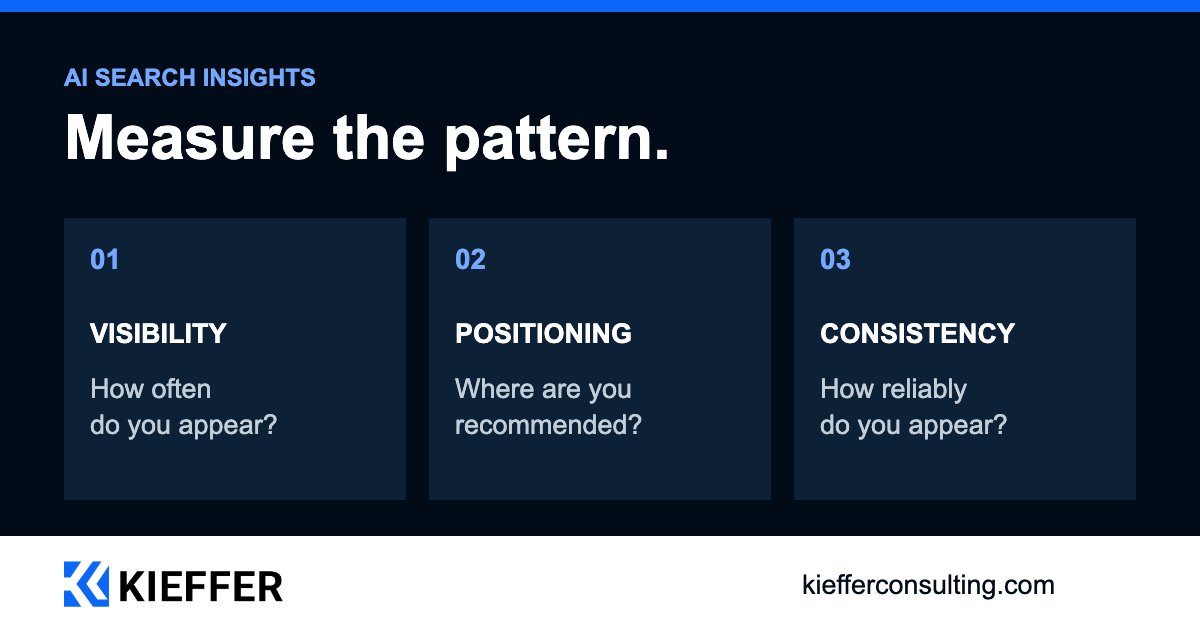
At Kieffer Consulting, I think a useful framework starts with three measures.
AI visibility: In how many relevant test searches does your business appear? If you're mentioned in seven of ten comparable responses, that's more meaningful than one impressive screenshot.
AI positioning: When you appear, are you the first recommendation, in a shortlist, or merely an alternative? Track this separately from visibility.
AI recommendation consistency: How reliably do you appear across repeated searches, carefully chosen wording variations, locations, and platforms?
These are practical measurement concepts, not universal industry standards. Results should be reported with the prompts, dates, locations, platforms, and sample sizes used.
A business that appears consistently among the recommended options may have more dependable exposure than one that appears first once and disappears in most other tests.
Can Businesses Optimize for AI Search?
Yes—but nobody can credibly guarantee first place in every AI answer.
Start with a website that clearly explains your services, locations, specialties, experience, and what sets you apart. Don't make a search system—or a potential customer—guess.
Strengthen your presence beyond your own site. Relevant third-party coverage, local and industry organizations, accurate directories, and authentic customer reviews provide additional places where your reputation can be understood and checked.
Keep business information accurate across major profiles. Conflicting addresses, service areas, and descriptions create unnecessary confusion.
Publish evidence of actual expertise: useful answers, project examples, processes, and case studies you have permission to share. Generic content written only to repeat keywords won't distinguish your business.
And don't abandon traditional SEO. Clear site architecture, crawlability, useful pages, and technical fundamentals remain essential. OpenAI distinguishes its search crawler from its training crawler.[3] Google says existing SEO best practices remain relevant to AI Overviews and AI Mode, with no special optimization required and no guarantee of inclusion.[4]
The Biggest Mistake Is Testing Once and Declaring Victory
I understand the excitement of asking ChatGPT for a recommendation and seeing your business at the top. But try the question again. Change the wording. Start a fresh conversation. Compare another AI platform. Check a nearby location.
Then look at the pattern rather than the most flattering result.
A basic test can begin with ten to twenty realistic customer questions, repeated in controlled sessions. Record mentions, recommendation positions, cited sources, and how accurately the business is described. Repeat the study over time.
Separate observations from explanations. If rankings move, don't automatically conclude the model changed its algorithm or that your SEO improved or declined overnight.
The Opportunity Is Bigger Than the Challenge
I don't see these fluctuations as a reason to distrust AI search or give up on optimization. I see them as a reason to measure more intelligently.
The questions businesses should ask are changing. Not just “Where do I rank?” but “How often am I recommended?” “Is the description accurate?” “Which competitors appear?” and “What credible information helps customers and AI systems understand us?”
Traditional search rankings still matter. But AI-driven discovery calls for a broader view of visibility.
In the age of AI search, the goal isn't simply to be recommended once. It's to become a business AI systems consistently recognize, understand, and recommend.
Build a More Dependable Search Presence
Want to understand where your business appears in AI answers and where it is missing? Start a conversation with Kieffer Consulting.
About Kieffer Consulting
Kieffer Consulting helps businesses improve digital visibility through SEO, AI Search Optimization (AEO/GEO), website strategy, and digital marketing. Learn more at kiefferconsulting.com.
Sources
2. OpenAI: Searching the web with ChatGPT